


Why is my AC running but not cooling?
When your AC runs but the room stays warm, the cause is almost always one of four things: poor airflow, a fault in the outdoor unit or its control board, the power supply, or low refrigerant. Some of these you can check yourself in ten minutes. The rest need a technician with gauges and a meter. Here is how to tell the difference, with the same numbers our technicians use on Guam.
Check These First: 10 Minutes, No Tools
- Remote settings. The mode is Cool (the snowflake), not Fan, Dry or Auto, and the set temperature is below the room temperature. Weak remote batteries can leave the old setting in place.
- Give it a few minutes. After the power comes on or the mode changes, the outdoor unit waits about 3 minutes before the compressor starts. When the room reaches the set temperature, an inverter slows down or pauses the outdoor unit. Both are normal.
- Breaker. The AC breaker is on. If it trips again right after you reset it, leave it off and book a visit.
- Filters. If your model has removable filters, take them out and rinse them. A clogged filter alone can cut airflow enough to make the room feel warm.
- Outdoor unit. With the AC on, the outdoor fan should spin and blow warm air. Clear away leaves, plants and anything closer than 1 foot (30 cm) to the unit.
- Doors and windows. A unit sized for a closed bedroom will not keep up with an open door to the living room.
Give the AC 15 minutes after any change before you judge it.
Measure the Temperature Drop
A simple kitchen or digital thermometer tells you more than the feel of the air. Run the AC on Cool with the fan on high for 15 minutes. Hold the thermometer at the top of the indoor unit, where room air goes in, for one minute and write down the reading. Then hold it in the cold air coming out of the louvers for one minute. Subtract the second number from the first.
| Temperature drop | What it usually means |
|---|---|
| 15–22°F (8–12°C) | The AC is cooling normally. If the room is still warm, the unit is too small or the room gets too much heat. |
| 10–15°F (5–8°C) | Weak cooling: dirty filters or coil, low airflow, or the start of a refrigerant problem. |
| Under 10°F (under 5°C) | Something is wrong: the outdoor fan has stopped, the compressor is running too slowly or not at all, or refrigerant is low. |
| 0–3°F | The compressor is not running. On a modern inverter, the usual suspects are the control board, a sensor, the supply voltage or the link between the indoor and outdoor units. |
On very humid days the drop can be 2–3°F smaller, because part of the AC's work goes into pulling water out of the air.
Common Causes, from Simple to Serious
| What you notice | Likely cause | What fixes it |
|---|---|---|
| Air is slightly cool, airflow is weak | Dirty filters, coil or blower wheel | Rinse the filters; professional cleaning from $110 |
| Indoor fan runs, outdoor unit is silent, room stays warm | Outdoor control board damaged by ants, a gecko or corrosion; no power to the outdoor unit; a communication fault between the units | Diagnosis; control board replacement $300 + part |
| Outdoor unit runs, but its fan does not spin | DC fan motor or its drive on the control board | Fan motor replacement $200 + part, or board repair |
| Outdoor unit runs, air is still warm | Low refrigerant from a leak, a stuck expansion valve, or a compressor problem | Leak search and repair, then recharge by weight |
| Ice on the copper pipes or the indoor coil | Very low airflow or low refrigerant | Turn cooling off, let it melt, book a diagnostic visit |
| Cools for a while, then stops with a code | Protection: compressor too hot (often low refrigerant), dirty outdoor coil, voltage out of range, failed sensor | Outdoor coil cleaning; refrigerant, sensor and voltage checks |
| Lights blink or the display shows a code | The control board stopped the unit to protect it | Take a photo of the code and book a diagnostic visit |
| Central system hums but does not start | Run capacitor or contactor | Capacitor or contactor replacement, $200 |
| Cools in the morning, not in the afternoon | Unit too small for the room's heat | A larger unit or a second unit |
Dirty Filters, Coils and Fans
The indoor coil needs a steady flow of air across it. Dust on the filter, slime on the coil and buildup on the blower wheel, the long fan barrel behind the louvers, all cut that flow. With less air, the coil removes less heat, and it can get cold enough to freeze. On Guam, where the AC runs most of the year in humid air, this buildup forms faster than on the mainland.
Rinsing the filters every 2 weeks helps, but only a full cleaning reaches the coil and the blower wheel. We recommend AC cleaning every 6 months. See what is hiding inside your air conditioner.
Inside a Modern Inverter: Boards, Sensors and Protection
Almost all wall-mounted mini-splits sold in the last eight years or more are inverter units. Instead of switching the compressor fully on and off, the outdoor control board changes its speed to match the room. There is no start capacitor and no contactor for the compressor. The electronics do that work:
- Inverter board. It turns the incoming 110 V or 220 V AC into DC, about 300–340 V DC on a 220 V unit, and drives the compressor through an inverter power module (IPM) at the speed the room needs.
- DC fan motors. The indoor and outdoor fans are driven by the boards, and the boards check that each fan reaches the speed they asked for.
- Temperature sensors. Small thermistors read the room air, the indoor coil, the outdoor coil, the outdoor air and the compressor discharge pipe. The board uses them to set the speed and to protect the compressor.
- Electronic expansion valve. On many models, the board also meters the refrigerant with a motor-driven valve.
- Communication line. The indoor and outdoor boards talk constantly over the signal wire between the units.
If a reading goes out of range, the voltage is too low or too high, or the boards lose contact, the board stops the compressor and shows an error code. On many Midea wall units, for example, E1 points to a communication fault between the indoor and outdoor units, P0 to the inverter module and P1 to supply voltage protection. Codes differ between models, so a code tells the technician where to start, not which part to replace.
After a power outage, switch the AC off at the breaker for a few minutes, then turn it back on. If the code comes back, take a photo of it and book a diagnostic visit.
Why Inverter Boards Fail on Guam
Most of the boards we replace on Guam were not worn out. Something got into them:
- Ants. Colonies move into the electrical compartment of the outdoor unit, most often while the unit sits switched off, and build nests right on the board. When the unit starts, their bodies and nest material bridge the contacts and short the circuit.
- Geckos. A gecko that gets into the electrical compartment and lies across the terminals shorts them when the power comes on, often burning the board and the gecko with it.
- Moisture and corrosion. Humid, salty air condenses inside the box, and the board, its connectors and the terminal block corrode until the circuits fail.
- Power problems. Voltage dips and surges during outages, storms and switching to a generator damage the inverter module and the power supply on the board.
Keep the covers of the outdoor unit in place, keep plants and debris away from it, and have it cleaned along with the indoor unit, because insects settle in dirty, quiet spots, especially in units that sit unused. For equipment that keeps getting hit by outages, we install a voltage monitor for $280 in a small box next to the outdoor disconnect. It cuts the power when the voltage runs too high or too low and turns it back on after the voltage settles. See why AC control boards fail on Guam.
How We Diagnose a Board Problem
Often the cause is clear as soon as the cover comes off: ants or a gecko on the board, burned tracks, green corrosion on the connectors. In that case the board is replaced. If the board looks clean, we test before we replace it, because a board costs more than most repairs:
- read the error code and, if the unit stores it, the fault history;
- measure the supply voltage at the terminal block with the unit running;
- check the signal wire and the connections between the units;
- measure each temperature sensor and compare it with the manufacturer's resistance table;
- check the compressor windings, which should give three equal readings, and the fan motors;
- check the DC voltage on the board while the compressor starts.
A clean board is replaced only when the wiring, sensors, compressor and fan motors check out. Control board replacement is $300 plus the part. The board's capacitors hold a dangerous voltage for minutes after the power is off, so this is not a job to try yourself.
Central Systems: Capacitor and Contactor
Many central systems still start the compressor with a run capacitor and switch it with a contactor, and so does the occasional older fixed-speed mini-split. Central systems from the last couple of years increasingly come with control boards as well.
- Capacitor. A metal can rated in microfarads (µF), for example 35/5 µF, that helps the compressor and the fan motor start and run. If it reads outside the tolerance printed on it, usually ±5% or ±6%, or its top is swollen, it is replaced.
- Contactor. The switch that sends power to the compressor and the outdoor fan. Its contacts burn and pit over time, and insects can nest inside and block them.
Capacitor or contactor replacement is $200. See all repair prices.
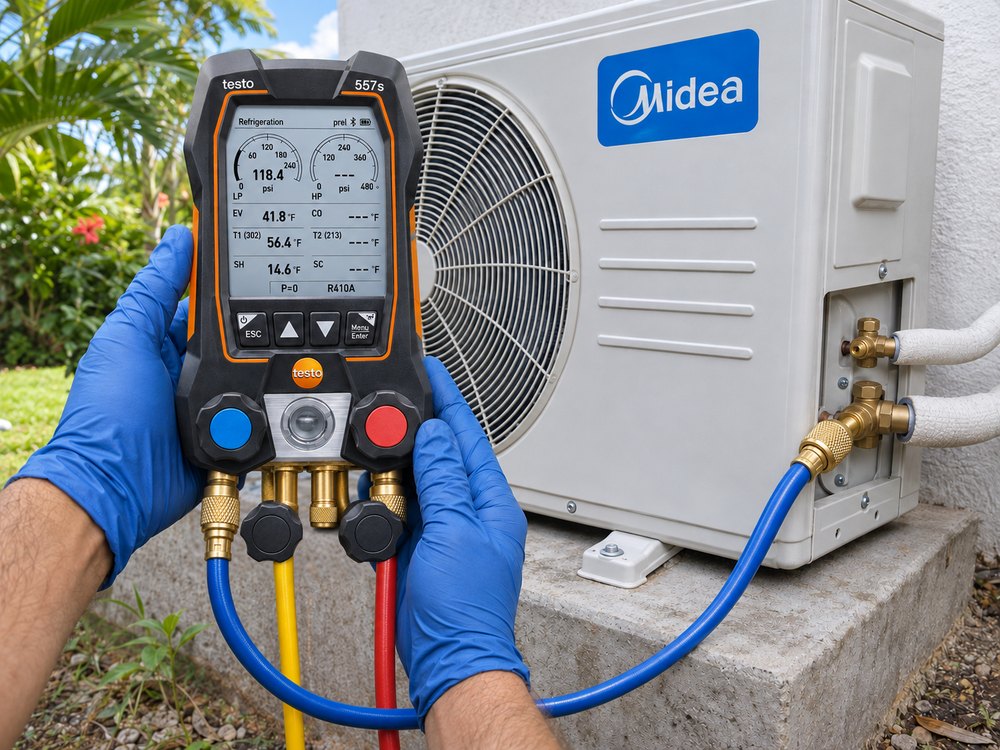
Low Refrigerant: How We Check It
A sealed air conditioner does not use up refrigerant. If the charge is low, there is a leak. Typical signs: the outdoor unit runs but the temperature drop is small, ice forms on the larger copper pipe or the indoor coil, the unit stops with a high discharge temperature code, or there are oily spots on the pipe connections.
Which refrigerant your AC uses matters for the repair. Most units installed on Guam in recent years run on R-410A. Since January 1, 2025, new air conditioners made for the U.S. must use a refrigerant with a much lower global warming potential, so new models, including the Midea units we sell, now come with R-454B or R-32. Units made earlier with R-410A can still be installed and serviced. R-454B and R-32 are classed A2L, mildly flammable, so they need tools, leak detectors and recovery equipment rated for A2L refrigerants, and a technician trained to use them. The refrigerant type is printed on the outdoor unit's nameplate.
On an inverter, pressures change with compressor speed, so the technician first runs the unit in its test mode at a fixed speed, then connects gauges to the service port on the outdoor unit. On a hot day, an R-410A system usually shows a suction pressure of about 115–130 psig, which means the refrigerant boils at about 40–45°F inside the indoor coil. R-454B runs a little lower and R-32 a little higher. Pressure alone is not enough: the technician also measures the pipe temperatures and calculates superheat and subcooling. These show whether the charge is really low, or the problem is airflow or the expansion valve.
If the charge is low, we find the leak first. A leak at a flare connection, typical of a poor installation, is fixed by redoing the connection. A leak from corrosion in the copper tubing of a coil, typical after 3–4 years on Guam, is different: patching one pinhole rarely lasts, so on a wall-mounted mini-split, where such a repair starts at about $500, replacing the unit usually makes more sense. On a central system, a single corroded spot can be worth repairing at about $800 with the pressure test and recharge, with no guarantee it will hold.
After a repair, the system is evacuated below 500 microns to remove air and moisture, and the charge is weighed in: a mini-split leaves the factory with refrigerant for a standard line length, and the manufacturer specifies how much to add for longer lines. A recharge without fixing the leak only buys time; see what can go wrong with an AC recharge. A recharge for a 7,000–12,000 BTU wall unit is $110 as a separate visit, or $90 added to a cleaning. Leak search and repair are priced separately; see refrigerant leak repair and recharge.
Unit Too Small or Room Too Hot
If the temperature drop is normal but the room never cools, the unit is probably too small for the heat coming in. A bedroom under a flat concrete roof or with large west-facing windows can need one size up. On Guam, plan on about 30 BTU per square foot: a 9,000 BTU unit covers up to about 300 sq ft. See how many BTU your room needs.
What a Diagnostic Visit Costs
| Type of AC | Diagnostic visit |
|---|---|
| Wall mounted | $40 |
| Ceiling mounted | $50 |
| Cassette | $50 |
| Ceiling ducted / central | $60 |
Your technician checks the power supply, the remote or thermostat, airflow, the outdoor unit, the error codes, the electrical parts and the refrigerant pressures. You get the cause and the price of the repair before any work begins.
Repair or Replace?
On Guam, salt air, humidity and year-round running wear air conditioners out much faster than on the mainland: most last about 5–7 years. Most cooling problems are still worth repairing. Replacement makes sense when the compressor has failed, or when a unit that has already worked five or six years needs a board or another expensive part and keeps breaking down. A new Midea wall-mounted unit starts at $1,050 with basic installation, and many models qualify for a GPA rebate of $100 to $600. See Midea air conditioners with installation, and compare running costs in how much a high-SEER AC can save on your power bill.
Common Questions
Why is my AC blowing air but not cold? Usually the outdoor unit is not running. On a modern inverter on Guam, the most common reason is a control board damaged by ants, geckos or corrosion; others are a failed sensor, the supply voltage or the link between the indoor and outdoor units. On central systems, it is often a capacitor or contactor. Low refrigerant is the other common cause.
Why does my outdoor unit stop when the room is cool? That is normal for an inverter. When the room reaches the set temperature, it slows down or pauses the outdoor unit, then speeds up again as the room warms.
Can I just add refrigerant? Only after the leak is found and fixed. A properly sealed system never needs a top-up, so low refrigerant always means a leak.
Should I keep running an AC that is not cooling? Not if you see ice, the outdoor unit runs with the fan stopped, or the breaker trips. Running it like that can damage the compressor. Turn it off and book a visit.
Is my aircon too old to fix? On Guam, most air conditioners last about 5–7 years. If yours is near that age and needs an expensive part, your technician compares the repair cost with a new unit and tells you both numbers.
Still warm inside? Book a diagnostic visit and tell us what you noticed. See other common AC problems or read Why is water leaking from your AC?
Need Help with Your AC?

AEL&L is a licensed HVAC contractor serving homes and businesses throughout Guam. With over 20 years of HVAC experience and operations on Guam since 2019, we provide AC cleaning, preventive maintenance, diagnostics, repairs, installation, and replacement. Our mobile team comes to your location to help keep your air conditioning running reliably. Book an appointment online anytime, choose your preferred date and time, and tell us about your AC needs. Read more about AEL&L





Toll-Free:
+1 (800) 706-2719
Local:
+1 (671) 488-8417
Email: info@aellco.com
Phone hours:
Daily · 8:00 AM–5:00 PM
Message us 24/7
© 2026 AEL&L LLC. All rights reserved.
- Toll-Free
- +1 (800) 706-2719
- Local
- +1 (671) 488-8417
- info@aellco.com
© 2026 AEL&L LLC. All rights reserved.
