


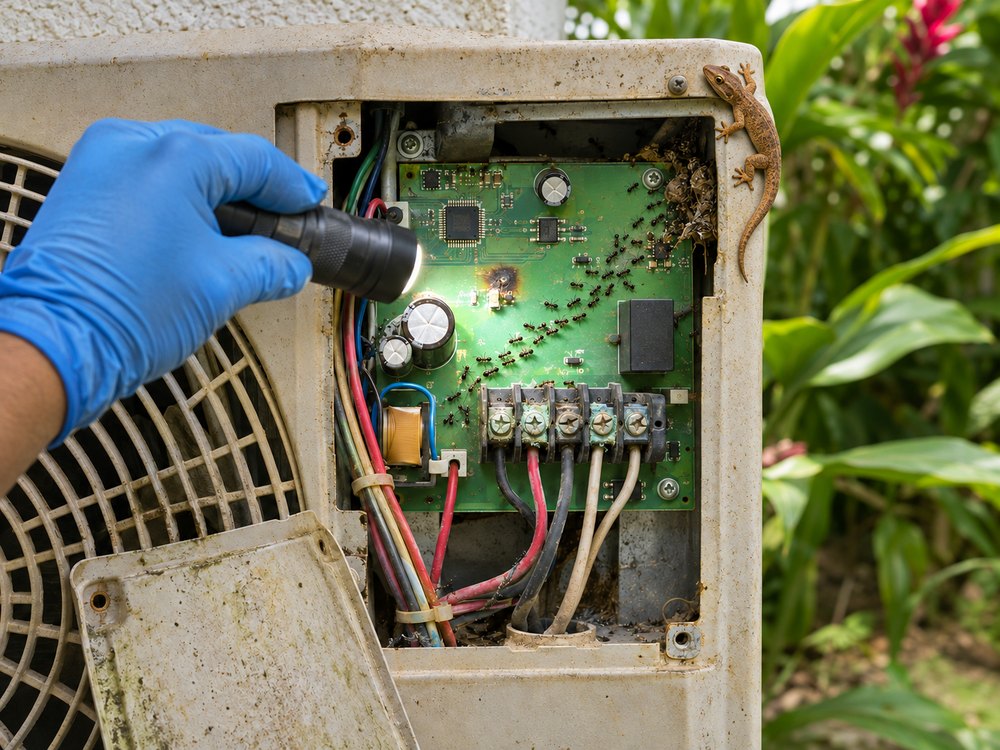
Why do AC control boards fail on Guam?
By Andrey Kurtin, CEO of AEL&L LLC, a licensed HVAC contractor on Guam (CLB19-1562), with more than 20 years in air conditioning.
On Guam, the most common expensive repair on a mini-split is a failed control board, and most of the boards we replace did not simply wear out. Something got to them: ants, a gecko, moisture and salt, or a power surge. Replacing a board costs about $450, close to half the price of a new wall unit, so it pays to know what causes the damage, what helps and what does not.
What the Control Board Does
The control board is the brain of an inverter air conditioner, and on the outdoor unit it also handles the power. The outdoor board converts incoming power into high-voltage DC and drives the compressor and fan at whatever speed the room needs. The indoor board reads the sensors and the remote and stays in constant contact with the outdoor board. When a board fails, the whole unit stops, usually with an error code. For more on how inverter units work, see why your AC runs but does not cool.
Ants, Geckos, Salt Air and Power Surges
Most board failures come down to four causes, and on Guam all four are everyday conditions.
- Ants. Ants get into almost any outdoor unit through cable openings, vents and gaps. The danger is a colony that settles in the electrical compartment, on the board itself: the bodies and nest material bridge the contacts, and the circuit shorts as soon as power flows.
- Geckos. Geckos live under and around outdoor units and under the eaves. Trouble starts when one gets into the electrical compartment and lies across the terminals; the moment the power comes on, it shorts them. Newer units close this compartment more tightly, but how well depends on the manufacturer and the model.
- Moisture and salt. Humid, salty air gets into the compartment and condenses on the board. Over months, the board, its connectors and the terminal block corrode until a circuit fails. This is one of the most common causes we see.
- Power problems. Dips and surges during outages, storms and generator switchovers damage the inverter module and the board's power supply.
Idle Units Are at Higher Risk
Timing matters. In our experience, an air conditioner that sits switched off for days or weeks is more likely to lose its board than one that runs every day. While the unit sits idle, its electrical compartment is quiet and still, and ants and geckos move in and settle there. When the unit is switched back on, the nest or the gecko shorts it.
If a unit has sat unused for weeks (in a spare room, an empty rental, or while you were off-island), have it checked and cleaned before you turn it back on.
How to Protect Your AC Board
On Guam, there is no way to make an outdoor unit insect-proof, and no spray or bait keeps ants out for good. What does help:
- If an ant nest is right next to the outdoor unit, remove it.
- If ants have moved into the air conditioner itself, have a technician clean them out. Don't spray insecticide into the unit; the liquid can damage the board and the plastic parts.
- Keep plants, debris and stored items away from the outdoor unit.
- Have the outdoor unit cleaned and inspected along with the indoor unit. A technician who opens it regularly spots ants, nests and corrosion before they reach the board.
- If power problems keep hitting your equipment, add a voltage monitor ($280). It sits in a small box next to the outdoor disconnect, cuts the power when the voltage runs too high or too low and restores it once the voltage settles. It is not a lightning arrester.
Signs of a Damaged Control Board
- The AC does not turn on at all.
- The display shows an error code, often a communication or inverter code.
- The indoor unit runs, but the outdoor unit does not start.
- You smell burning near the outdoor unit, or the breaker trips.
If you see any of these signs, switch the AC off at the breaker or the outdoor disconnect and book a diagnostic visit. Keep the cover closed: the board holds a dangerous voltage for several minutes after the power is cut.
Control Board Replacement Cost on Guam
| What you pay for | Cost |
|---|---|
| Diagnostic visit, wall-mounted unit | $40 |
| Labor to replace the control board | $300 |
| The board itself, usually | about $150 |
| Typical total for a board repair | about $450 |
| New Midea wall unit with basic installation | from $1,050 |
On Guam, most air conditioners last about 5–7 years. If yours is near that age and needs a board, compare the repair with a new unit. Midea units start at $1,050 with basic installation, and many models qualify for a Guam Power Authority (GPA) rebate of $100–$600; see how to get the GPA rebate and Midea air conditioners with installation.
Common Questions
How do I get ants out of my AC unit? Switch the unit off at the breaker and call a technician. Don't spray insecticide inside: the liquid can damage the board and the plastic parts, and the nest still has to be cleaned out.
Why do ants get into air conditioners? The electrical compartment of an idle unit is a quiet, sheltered spot with openings for the cables, and on Guam ants find their way into almost any unit.
Some companies offer to coat the board with a protective spray. Is it worth it? We don't recommend it. The inverter module and other parts sit on heat sinks and have to shed heat; a coating can get into connectors and relays and make parts run hotter, and it may void the manufacturer's warranty. That is also why manufacturers don't seal their boards completely.
How much does AC control board replacement cost on Guam? With us, $300 for labor plus the part, which usually costs about $150, so around $450 in total. A diagnostic visit for a wall-mounted unit is $40.
AC dead or showing a code? Book a diagnostic visit. See also AC repair in Guam and repair prices.
Need Help with Your AC?

AEL&L is a licensed HVAC contractor serving homes and businesses throughout Guam. With over 20 years of HVAC experience and operations on Guam since 2019, we provide AC cleaning, preventive maintenance, diagnostics, repairs, installation, and replacement. Our mobile team comes to your location to help keep your air conditioning running reliably. Book an appointment online anytime, choose your preferred date and time, and tell us about your AC needs. Read more about AEL&L



Toll-Free:
+1 (800) 706-2719
Local:
+1 (671) 488-8417
Email: info@aellco.com
Phone hours:
Daily · 8:00 AM–5:00 PM
Message us 24/7
© 2026 AEL&L LLC. All rights reserved.
- Toll-Free
- +1 (800) 706-2719
- Local
- +1 (671) 488-8417
- info@aellco.com
© 2026 AEL&L LLC. All rights reserved.
