


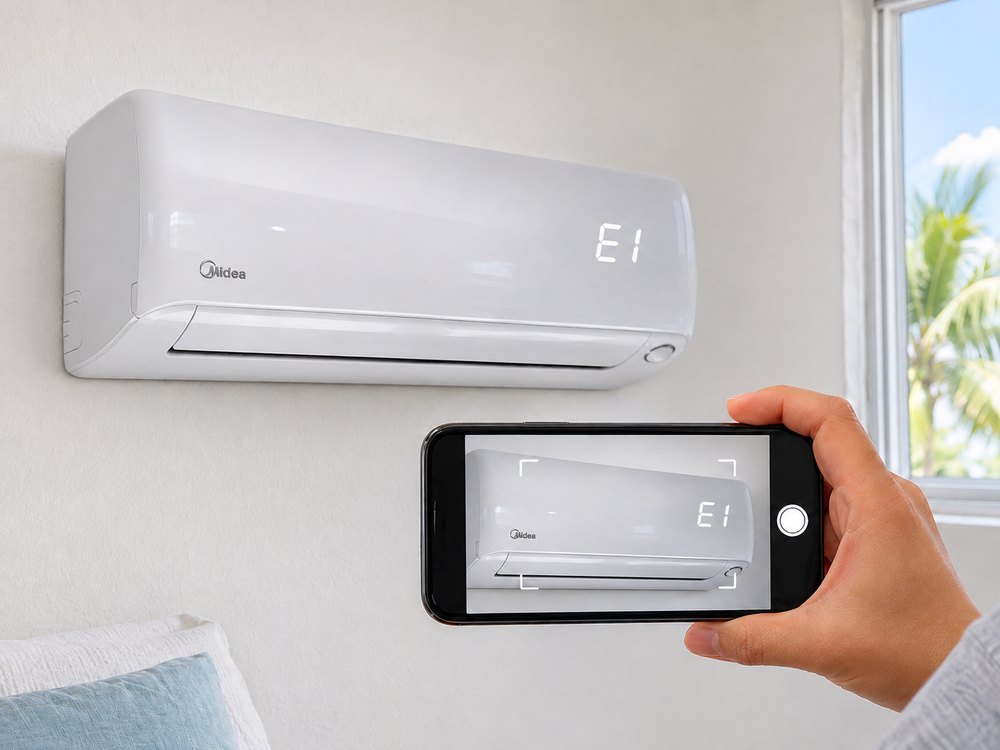
Mini-split error codes: what E1, P0 and P1 mean
By Andrey Kurtin, CEO of AEL&L LLC, a licensed HVAC contractor on Guam (CLB19-1562), with more than 20 years in air conditioning.
An error code such as E1, P0 or P1 means your mini-split has stopped itself to protect its parts. Its control board watches temperatures, voltage, fan speeds and the link between the indoor and outdoor units. When one of them goes out of range, the board stops the compressor and shows a code. The code tells you which part of the system raised the alarm. It does not tell you which part failed, and that difference matters before you pay for a repair.
Error Codes Are Not Universal
There is no industry standard for air conditioner error codes. Each brand keeps its own list, and the lists change between series and model years of the same brand. On many Midea wall units, E1 is a communication fault between the indoor and outdoor units; on some other brands, the same E1 stands for high-pressure protection. The owner's manual for your exact model lists its codes, so a code is useful only together with the model number on the unit's nameplate.
Midea Mini-Split Error Codes
The codes below mean the same thing on most Midea wall-mounted mini-splits. Newer Midea units show two-part codes, such as EL 01 instead of E1, so the table lists both formats. If your unit shows a different code, or the meaning does not seem to fit, check the manual or send us a photo of the code and the model number.
| Older models | Newer models | What it usually means | What you can do |
|---|---|---|---|
| E0 | EH 00 | Memory (EEPROM) error on the indoor board | Restart once; if it returns, book a visit |
| E1 | EL 01 | No communication between the indoor and outdoor units | Restart once; if it returns, book a visit |
| F1 | EC 53 | Outdoor air temperature sensor fault | Book a visit |
| F2 | EC 52 | Outdoor coil temperature sensor fault | Book a visit |
| F3 | EC 54 | Compressor discharge temperature sensor fault | Book a visit |
| P0 | PC 00 | Inverter module (IPM) protection | Don't keep restarting; book a visit |
| P1 | PC 01 | Supply voltage too high or too low | Wait for stable power, then restart once |
| P2 | PC 02 | Compressor overheating protection | Turn it off, clear around the outdoor unit; if it returns, book a visit |
| P4 | PC 04 | Inverter compressor drive fault | Book a visit |
| — | EL 0C | Refrigerant leak detected | Turn it off, open a window, book a visit |
Other brands use their own letters and numbers, but their codes fall into the same few groups: communication between the units, temperature sensors, supply voltage, the inverter module and compressor, overheating or pressure protection, fan motors and, on some newer R-454B and R-32 units, a refrigerant leak sensor. Whatever the brand, each group has several possible causes.
What You Can Safely Do Yourself
A few steps are safe for anyone before calling a technician:
- Take a photo of the code and of the nameplate with the model number.
- Check the remote: batteries, mode and set temperature.
- Switch the AC off at the breaker or the outdoor disconnect for 3–5 minutes, then turn it back on once.
- If the code returns, leave the unit off. Restarting it again and again stresses the compressor and the board.
- Keep the covers closed. The control board holds a dangerous voltage for several minutes after the power is cut.
Turn the AC off right away and call us if you smell burning, the breaker trips, water drips near electrical parts or ice forms on the pipes. If the display shows a refrigerant leak code, also open a window.
Why One Code Can Have Several Causes
Take the communication code as an example. It appears whenever the indoor and outdoor boards stop exchanging signals. The cause can be the signal wire between the units, the indoor board, the outdoor board or the power supply to the outdoor unit, and all four look the same on the display. Our technician tells them apart by measuring voltage and signal at the terminal blocks of both units while the system starts. Replacing a part on the strength of a code alone is a guess, and with control boards, an expensive one. Only a diagnostic visit shows whether your code comes from the board, the wiring or something else.
The Two Most Common Repairs Behind a Code
On Guam, a code that does not clear after a restart usually leads to one of two repairs.
- A control board. This is the most common one. Replacing a board costs $300 for labor plus the part, usually about $150, so around $450 in total, close to half the price of a new wall unit. On Guam, boards are usually killed by ants, geckos, moisture, salt air or power surges; see why AC control boards fail on Guam.
- A refrigerant leak. On a new unit, a leak usually comes from the installation, most often at a flare connection, and redoing the connection fixes it. On a unit that has run 3–4 years on Guam, it is usually corrosion in the thin copper tubing of a coil, and patching one pinhole rarely lasts: in our experience, another opens within weeks or months. On a wall-mounted mini-split, that repair starts at about $500, half the price of a new unit, so replacement usually makes more sense. On a central system, where replacement costs $4,000–6,000, fixing a single corroded spot (about $800 including the pressure test and recharge) can be worth a try, but no one can promise it will hold. See refrigerant leak repair and recharge.
Error Codes After a Power Outage
Outages and voltage spikes often leave a voltage or communication code behind. Wait until the power is stable, switch the AC off at the breaker for 3–5 minutes and restart it once. If the code stays, the outage may have damaged the board. If power problems keep hitting your equipment, we can install a voltage monitor ($280) in a small box next to the outdoor disconnect. It cuts the power when the voltage runs too high or too low and restores it once the voltage settles; it is not a lightning arrester.
How We Diagnose and What It Costs
When you book, mention the code, or send us a photo of the code and the nameplate on Messenger or WhatsApp. Your technician will arrive knowing the model and what to check first.
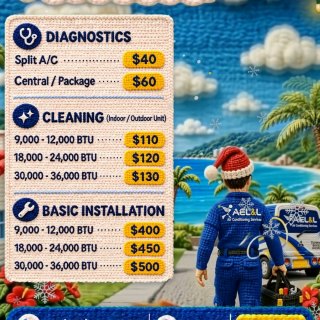
| Type of AC | Diagnostic visit |
|---|---|
| Wall mounted | $40 |
| Ceiling mounted | $50 |
| Cassette | $50 |
| Ceiling ducted / central | $60 |
You get the cause and the price of the repair before any work begins. See all repair prices.
Common Questions
What does E1 mean on a Midea mini-split? On most Midea wall units, E1 (EL 01 on newer models) means the indoor and outdoor units have lost communication. The cause can be the signal wire, either board or the power to the outdoor unit. Restart once at the breaker; if E1 comes back, book a diagnostic visit.
Can I clear an error code myself? A restart at the breaker clears it if the cause was temporary, such as a voltage dip. If the code comes back, the fault is still there.
Why does the code come back after a reset? Because the board finds the same problem again. Each restart adds stress to the compressor, so if the code returns after one restart, leave the unit off and book a visit.
Can I keep using the AC with an error code? Usually it will not run until the cause is fixed. If it keeps starting and stopping with codes, switch it off to protect the compressor.
Where do I find the model number? On the nameplate sticker on the side of the indoor unit, sometimes under the front panel, and on the outdoor unit.
Do you repair brands other than Midea? Yes. We diagnose and repair mini-split, ceiling, cassette and central systems from many brands, not only the Midea units we sell.
Code on the display? Book a diagnostic visit and send us a photo of it. See also why your AC runs but does not cool and other common AC problems.
Need Help with Your AC?

AEL&L is a licensed HVAC contractor serving homes and businesses throughout Guam. With over 20 years of HVAC experience and operations on Guam since 2019, we provide AC cleaning, preventive maintenance, diagnostics, repairs, installation, and replacement. Our mobile team comes to your location to help keep your air conditioning running reliably. Book an appointment online anytime, choose your preferred date and time, and tell us about your AC needs. Read more about AEL&L
Toll-Free:
+1 (800) 706-2719
Local:
+1 (671) 488-8417
Email: info@aellco.com
Phone hours:
Daily · 8:00 AM–5:00 PM
Message us 24/7
© 2026 AEL&L LLC. All rights reserved.
- Toll-Free
- +1 (800) 706-2719
- Local
- +1 (671) 488-8417
- info@aellco.com
© 2026 AEL&L LLC. All rights reserved.
